
Bitcoin Support and Resistance Levels
A practical guide to identifying key BTC price zones — how support and resistance levels form, why they matter, and how to use them in your Bitcoin price analysis.
What Are Bitcoin Support and Resistance Levels?
Bitcoin support is a price zone where buying interest has historically been strong enough to halt a decline and push BTC price higher. Traders treat support as a potential floor — an area where demand outweighs supply and where a bounce is more likely than a continued drop.
Bitcoin resistance is the opposite: a price zone where selling pressure has repeatedly prevented further upside. When BTC approaches resistance, sellers who bought at lower prices take profits, and traders who missed the rally short the market, creating a ceiling that price struggles to break through.
Together, support and resistance levels define the structure of the Bitcoin price chart. They are not precise price points but zones — areas where the balance between buyers and sellers has shifted in the past and is likely to shift again. The more times a level has been tested and held, the more significant it becomes.
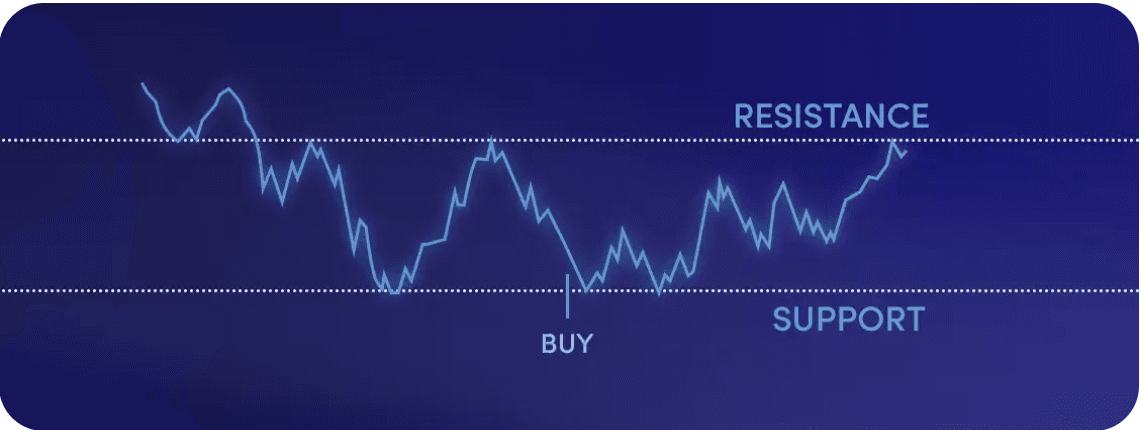
Price oscillates between support (buy zone) and resistance until a breakout occurs
Live Bitcoin Price Chart — Identify Levels in Real Time
Use the chart below to locate current BTC support and resistance zones. Look for price areas that have been tested multiple times — these are your key levels.
How Bitcoin Support and Resistance Levels Form
Support and resistance levels do not appear randomly. They form at specific price areas for identifiable reasons, which makes them repeatable and predictable enough to be useful in analysis.
Prior Highs & Lows
The most reliable Bitcoin support and resistance levels come from previous swing highs and swing lows on the chart. A prior high that capped price multiple times becomes strong resistance. A prior low that held multiple tests becomes strong support. These levels persist because traders remember them and place orders around them in future price cycles.
Round Number Levels
Psychological price levels — $50,000, $60,000, $100,000 — act as natural support and resistance in Bitcoin price analysis. Large option and futures positions cluster at these levels, amplifying price reactions when BTC approaches them. Round numbers attract attention from retail and institutional participants alike, making them self-fulfilling reference points on the Bitcoin price chart.
Moving Averages
The 50-day and 200-day moving averages are dynamic support and resistance levels that move with price over time. In a Bitcoin bull market, the 200-day MA often acts as a floor during corrections — price dips to it, finds buyers, and rebounds. In a bear market, these same moving averages become overhead resistance that caps recovery attempts. When Bitcoin price crosses the 200-day MA with volume, it is a widely watched structural signal.
Volume Profile Zones
High-volume trading zones — areas where a large amount of BTC changed hands over an extended period — create strong support and resistance because many traders have positions anchored at those price levels. When Bitcoin price returns to a high-volume zone after moving away, participants who bought or sold there previously react, creating predictable price behavior that technical analysts use to anticipate turning points.
Role Reversal: When Support Becomes Resistance
One of the most important concepts in Bitcoin support and resistance analysis is role reversal. When a support level breaks — meaning Bitcoin price closes convincingly below it — that level often flips and becomes new resistance on the next rally attempt.
The logic is straightforward: traders who bought at the support level and are now sitting at a loss will use any recovery back to that level as an opportunity to exit at breakeven. This selling pressure turns the old support into a ceiling. The same dynamic works in reverse: when Bitcoin breaks above a resistance level, that level becomes new support as buyers who missed the initial breakout look to buy on the next pullback to that zone.
Role reversal is most reliable when:
- The breakout or breakdown is accompanied by above-average volume
- Price spends time consolidating above (or below) the flipped level before continuing
- The level was tested multiple times before breaking
- The move occurs on the daily or weekly Bitcoin price chart rather than a short-term timeframe
Watching for role reversal setups is one of the most actionable ways to use support and resistance levels in live Bitcoin price analysis. A clean retest of a broken level — followed by a rejection — provides a defined entry point with a clear invalidation level nearby.
Support & Resistance Quick Reference
- Support holds → potential bounce, watch for bullish candle confirmation
- Support breaks → becomes resistance, next support level is the new target
- Resistance holds → potential pullback, watch for bearish rejection candle
- Resistance breaks → becomes support, measured move targets the next resistance level
- Multiple tests → the more times a level is tested, the more significant the eventual break
- Volume confirms → always check volume on breakouts and breakdowns
Using Bitcoin Support and Resistance in Practice
Identifying support and resistance levels is only the first step. The more useful skill is knowing what to do when Bitcoin price approaches one of these zones.
Trading Into Support
When Bitcoin price pulls back toward a known support zone, traders watch for confirmation before acting. A single touch of support is not enough — confirmation comes from a bullish reversal candle at the level (such as a hammer or bullish engulfing pattern) combined with a volume increase. The support level then defines the invalidation: if BTC closes clearly below it, the trade thesis is wrong and the position should be reconsidered.
Trading a Resistance Breakout
When Bitcoin price breaks above a resistance level that has been tested multiple times, it can signal the start of a significant move. The ideal entry is on a retest of the broken resistance as new support — this gives a lower-risk entry with the level now acting as a floor. Chasing a breakout at the initial spike carries higher risk, as fakeouts (false breakouts that reverse quickly) are common in Bitcoin price action, especially on shorter timeframes.
Bitcoin Support and Resistance — FAQ
What is Bitcoin support and resistance?
Bitcoin support is a price zone where buying interest has historically halted a decline and pushed BTC higher. Resistance is where selling pressure has repeatedly capped upside. These zones form at prior highs and lows, round numbers, moving averages, and high-volume trading areas. They are the foundation of Bitcoin price chart analysis.
How do you identify Bitcoin support levels?
Look for price zones where BTC has reversed upward multiple times on the daily or weekly chart. Key sources: prior swing lows, round number levels ($50K, $60K), high-volume zones, and the 50-day and 200-day moving averages. The more times a level has held, the more significant it is.
What happens when Bitcoin breaks a support level?
When Bitcoin breaks below support with conviction and volume, that level often flips to resistance — a concept called role reversal. The break signals sellers have overcome buying interest at that zone. Always confirm a breakdown with a candle close below the level, not just a wick pierce, to avoid reacting to false breakdowns.
Why are round numbers important in Bitcoin price analysis?
Round numbers like $50,000, $60,000, and $100,000 act as psychological support and resistance because they are natural reference points for traders and investors. Large options and futures positions cluster at these levels, amplifying price reactions when Bitcoin approaches them.